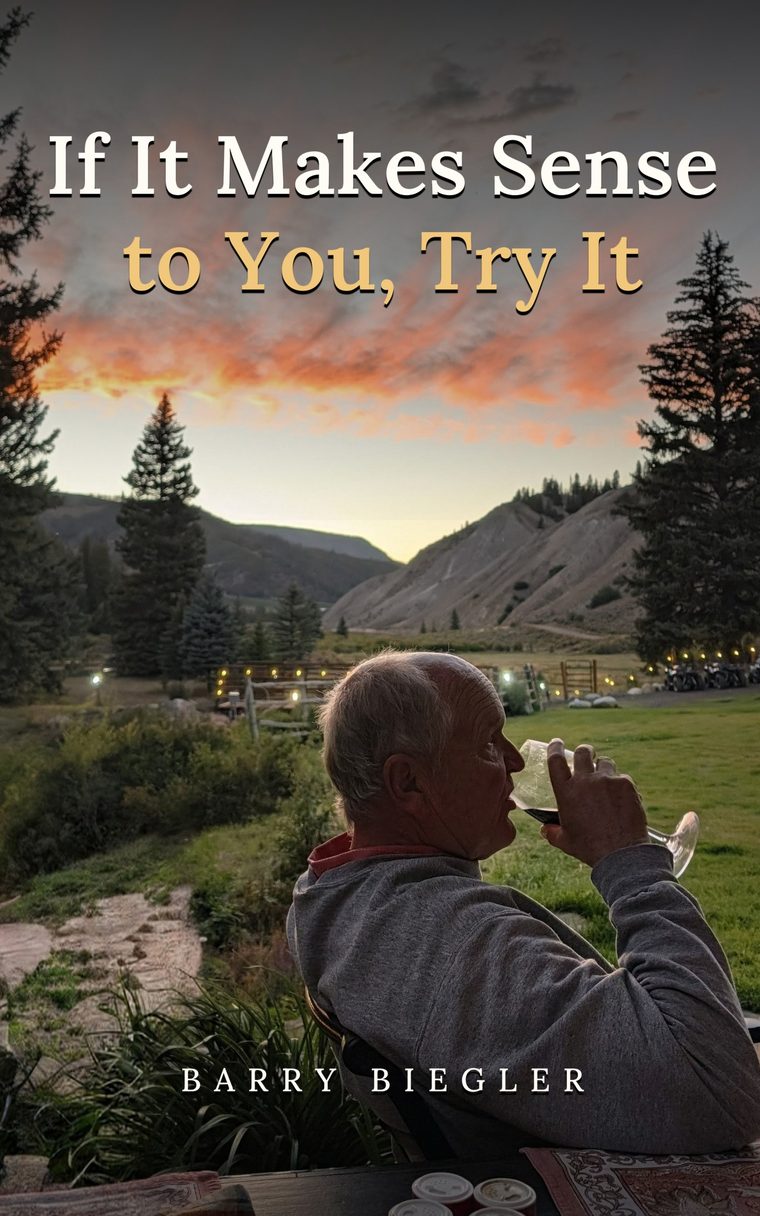
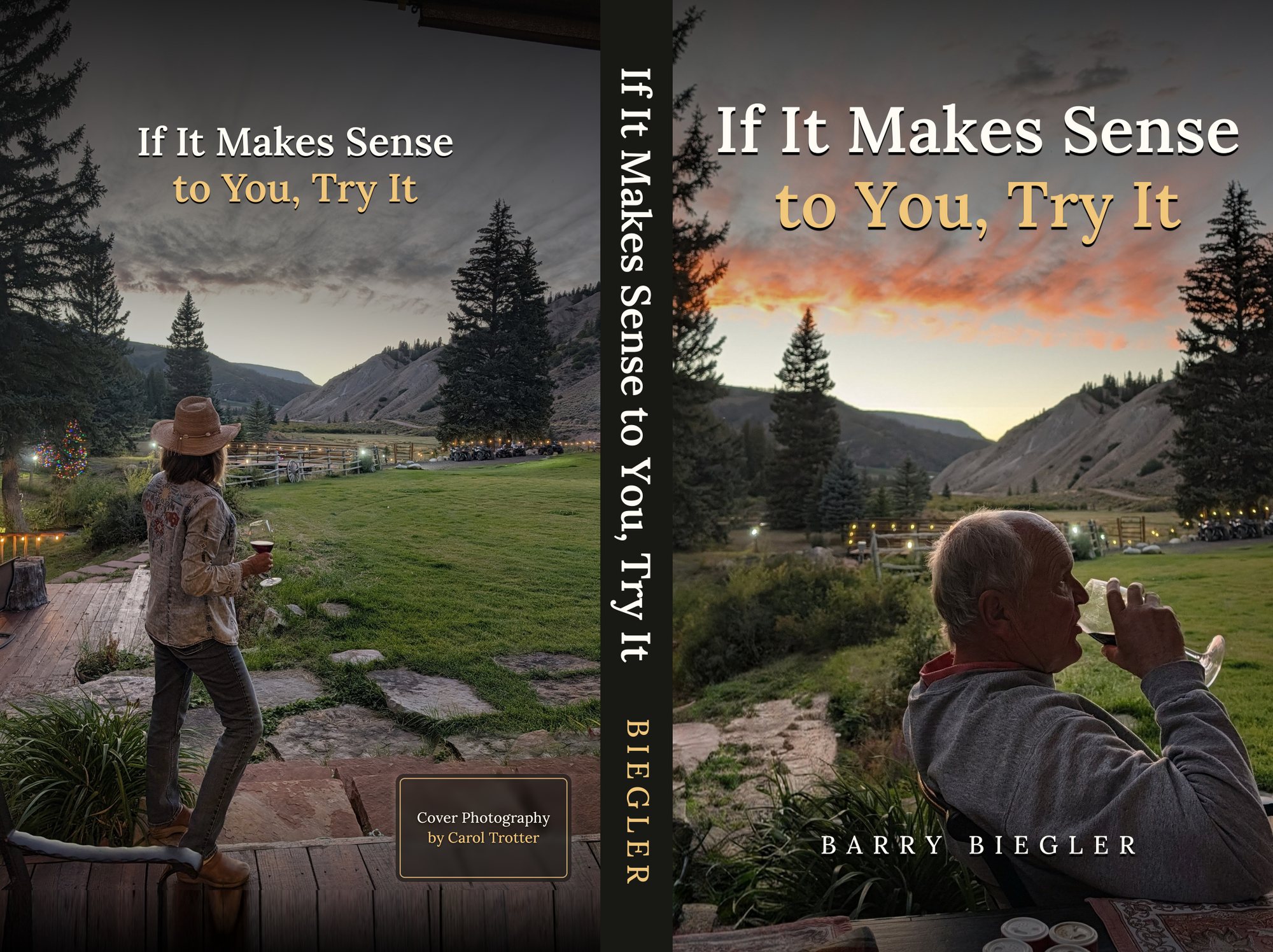
From the book If It Makes Sense to You, Try It, by Barry Biegler
What makes this book different
- No flashy slogans or promises to change your life in 10 days. The book asks the reader to try the phrases they like and skip the ones they think are stupid.
- Assumes the reader is smart and is looking for a variety of clear, logical ideas to evaluate without wasting a lot of time in the process.
- The entire book is available for free on this website.
- Reads like a man explaining something across a kitchen table.
- Each idea is 2 pages or less, so the book can be skimmed through to find stuff that might be useful.
Enjoying Life
Click on any phrase to read it.
Click a phrase on the left to read it.
Enjoy the Journey
I like to pursue goals, some of the most important of which take a significant amount of time to achieve. When I become focused on an important goal, I am like a dog with a bone. I cannot let it go. I move into “get it done mode.” I work on the goal constantly, either actively pursuing it or thinking about it virtually twenty-four hours a day. I might wake up in the middle of the night with an idea about how to get closer to it. I do not take time to eat well, exercise, relax, or spend time with friends and family. I put myself under constant stress and pressure. This “get it done at all costs” approach has helped me achieve many goals quickly, but at a terrible cost.
At some point, I became aware of the phrase “Enjoy the journey,” a common expression with no clearly established author. It strongly resonated with me because it was obvious that I was not enjoying the journey at all. I was making myself unhealthy and miserable along the way. It is easy to say, “I want to enjoy the journey,” but how exactly could I do that? I began keeping several principles in mind.
Make Enjoying the Journey Part of the Goal
The first thing I did was make it clear to myself that “get it done at all costs” was not good for me. Because I am goal-oriented, I made my new goal very clear. “Get it done, but enjoy the process along the way.”
Make Time for Other Things, Even When It Is Difficult
I had operated in “get it done at all costs” mode for a very long time and found it a difficult habit to break. I still find that if I am focused on a goal and my wife asks me to go to dinner, my first reaction is, “Absolutely not.” I have learned to catch that thought and change it to: “Going to dinner with my wife is a great way to enjoy the journey, which is now part of my goal. So yes, absolutely, let’s go.”
Put Events on the Calendar That Have Nothing to Do With the Goal
I use Google Calendar and tend to follow it religiously. Once I put an event on the calendar, I almost always do it. One of the most useful ways I have found to enjoy the journey is to schedule activities that have nothing to do with the goal.
I may stop working for a few hours, or perhaps an entire day, to plan those activities: golf on these days and at these times, workouts, dinners, and events with friends and family. I tend to get on a roll. Putting the first event on the calendar helps me add the next and then the next. If I expect the goal to take six weeks, I try to schedule other activities for the entire six weeks during the same planning session. If I try to add them one at a time later, I often forget to do it.
Celebrate Achieving Sub-Goals
Most major long-term goals can be broken into smaller goals. For example, while writing this book, a sub-goal might be to finish ten phrases in one week. I enjoy the journey more when I take time to celebrate achieving sub-goals, perhaps by having dinner with friends. At the dinner, I make it clear to myself and everyone else that part of the reason we are there is to celebrate.
I have heard many authors describe the difficulty and discomfort they experience during the writing process. I don’t want that to happen to me, so I have been actively applying these principles. As a result, I am enjoying the journey more than I would have. Taking time away from the book for recreation, family, friends, and my health is better than my previous “get it done at all costs” approach—and the book will still get done.
Always Get a Convertible
I love driving a convertible. Cruising around with the top down is just the best. I traveled a lot for my business and vacations, and rental companies charge more for convertibles than for a basic sedan. I wanted to be economical and always rented the basic.
One day I was driving my boring sedan around Miami going to a client and passed one convertible after another. The occupants seemed to be having a great time, hair blowing in the wind. Why was I in this stupid sedan? After meeting with the client, I went back to the airport and traded it for a beautiful red Mustang convertible, and I’ve been renting and buying convertibles ever since.
“Always get a convertible” does not mean “always buy lots of crazy stuff you can’t afford.” It reminds me that when my economics improve, my choices should change with them. My company was doing very well. I would never know the difference on the income statement. Renting the cheapest car might have been required in the past, but that was no longer true.
I have a habit of suppressing what I want for some damn reason. Even when I could easily afford the convertible, I still didn’t rent one. There is a part of me saying, “Hey, get the convertible,” and some other part dominates with, “No, you don’t deserve it.” The phrase “Always get a convertible” reminds me not to argue with the suppressive voice, as that just gives it power. Instead I think, “Ah, there you are again, trying to stop me. Guess what? I’m getting the convertible anyway.”
After realizing my economics had changed and dismissing that voice, I changed a lot of things:
- I started flying business class, not coach.
- I booked good hotels, not Holiday Inn Express.
- If I went somewhere like Hawaii, I stayed a few extra days after business was done rather than rush home to “get to work.”
Always get a convertible!
You’re Never Going to Remember a Layup
When I was 16, my dad took me to Pebble Beach for a round of golf. Pebble is perhaps the best course the public can play and is on almost every golfer’s bucket list. You may never get to play the course again.
The 18th hole at Pebble is the most famous. It is a par 5 with the Pacific Ocean on the left the whole way. After I hit my first two shots, I was still about 200 yards from the green, with nothing but ocean in between and the wind in my face. I was very intimidated, so I decided to play it safe. I took out a seven-iron and aimed away from the green, planning to lay up. As I was getting ready to hit the ball, I heard my dad yell, “What the hell are you doing? You’re never going to remember a layup. Take out your driver and aim at the green.”
This seemed like ridiculous advice. I was only 16 and weighed less than 100 pounds. A good drive might go 180 yards. I would have to make the best shot of my life to carry 200 yards into the wind over the ocean.
But he was my dad, and we were at Pebble Beach on the last hole. I took out the driver, hit the ball on the green and made a birdie four. If I had laid up with that seven-iron, I’m pretty sure I wouldn’t be writing about it in this book. I also told this story at my dad’s funeral because it was my best memory of him. My kids and friends are sick of hearing the story, but I tell it again and again.
I don’t mean to imply that it is a good idea to always try the near-impossible, risky thing. It would be stupid to run across an interstate highway on foot. Telling a story about “Hey, I ran across this incredibly busy highway and survived” would make me seem like a fool.
However, there have been many times in my life when I have faced a choice between the safe, boring, conventional path and taking a risk to pursue a dream. “You’re Never Going to Remember a Layup” reminds me that sometimes I do want to take the risky path because it may turn out to be far more memorable and meaningful.
Thanks, Dad.
Light Kills All Monsters
This book is a collection of phrases that help me, even a little bit. I’ve discovered that a phrase doesn’t necessarily have to be literally true to be helpful.
When I was growing up, I was afraid of the dark. I would imagine there was an evil monster in the corner that was going to come get me. My parents told me, “Don’t worry about it. There are no monsters. They don’t exist.” That didn’t help. One night my grandmother was babysitting and put me to bed. I told her about my fear of monsters, and she said, “Light kills all monsters.” Then she turned on a light in the corner. I remember thinking something like, “Oh, I didn’t know that. Thanks, Grandma.” If a light was on, the fear was gone. This is the first useful phrase I can remember using, and it wasn’t even true.
Even at 73 years old, I don’t like sleeping in a completely dark room and always have a nightlight. At one point I thought, “This is silly. I’m not five years old anymore. Let’s turn out the light.” When I did, it didn’t feel right. There was an uneasiness. I could have tried to teach myself how to sleep in the dark, talked to a therapist about it, or researched why I still wanted a light on. However, there was an easier solution: turn on a nightlight. Habits and solutions learned in childhood can be very hard to break, and there was no reason for me to break this one.
I don’t mean that it is a good idea to create lies and convince yourself they are true. In most cases, believing something that is not true can be very dangerous. “Strive to be perfect.” “Succeed at all costs.” “You have to love someone no matter how badly they behave.” These are all things I once believed that were not true and caused me problems.
“Light kills all monsters” is different. I know it isn’t literally true, but it helps me rather than causing problems. It has also become a pleasant thought that reminds me of my Grandma. I sometimes find myself in a hotel room looking for which light I can leave on that will illuminate the room just a little bit. With a bit of humor, I sometimes think, “Gotta kill those monsters, Grandma.”
Make Your Own Events
I like to play golf, but it takes some effort. Golf usually involves getting three other people to play to complete the foursome. Organizing can be difficult—some people I contact have conflicts, or I can’t even get ahold of them to ask.
Sometimes the frustration of being “the guy who arranges it” gets the better of me and I stop. I think, “I’ll just wait for these other guys to arrange stuff and ask me.” Unfortunately, that rarely happens. Instead, I just don’t get to play at all, and I miss it.
“Make your own events” reminds me to plow through the frustration and continue to book golf and other events. I may think, “Damn, why do I have to be the guy who arranges this?” The answer is, “Who knows why that happens? It doesn’t matter. If you want to play, stop bitching about it and book some tee times.”
I have some friends who are fantastic at creating events and inviting me. My wife and I went on vacation with another couple, and they arranged everything. It was such a pleasure to just go along for the ride and have great accommodations, travel arrangements, rental cars, daily excursions, etc. I know how hard it is to make all that happen, and I made sure to thank them repeatedly. I also try to create events and invite them, to even the deal.
Don’t Die at Your Maximum Net Worth
Studies show that many financially comfortable Americans spend surprisingly little of their savings during retirement. Some actually die with more money and assets than at any other point in their lives—at their lifetime maximum net worth.
I can see how this can happen. If I buy a house in my thirties for $300,000 and put 20% down, I have $60,000 of equity contributing to my net worth. Thirty years later the house has gone up to $750,000 and I have paid off the mortgage. My equity went from $60,000 to $750,000 just with time, appreciation, and diligently making mortgage payments. Other assets, such as stocks in a retirement plan, can also grow significantly over a thirty-year period.
When I was in my 60s and getting toward the retirement phase, I was at my maximum net worth. My house and stocks had increased like so many others. However, I wasn’t spending much, still thinking about “saving for my old age.”
One of my favorite phrases is, “Always take the best care of yourself you can.” Was having my maximum net worth, and yet spending very little, really taking the best care of myself?
I want to be clear that “taking the best care of myself” does not mean being selfish and spending all the money on me, and only me. Far from it. I like to help others and do charity work, so when I take some of that maximum net worth and help out an orphanage in Africa, it is “taking the best care of myself” because I am pursuing an important value.
My father helped me out financially when I was in my late 20s. His view was, “Why should you have to wait until I die to benefit?” I have never forgotten it. Using some of the money now, while I can see what it does, is much more valuable to me than more money in the stock market.
I’m not suggesting that someone wildly spend all their money and die broke. However, there is a very big range between “broke” and “maximum net worth.” There is a sweet spot in there someplace that is truly taking the best care of myself that I can, and it is not the maximum.
Don’t Think of Yourself as Old
I’m 73 years old, and I caught myself thinking the other day, “Damn, you’re getting old.” That got me thinking: What am I actually saying when I tell myself I’m getting old? Things like the following come to mind:
- I can’t do things as well as I used to.
- My body is starting to fail me.
- I should expect more aches, fatigue, forgetfulness, and limitations.
- Some activities may no longer be appropriate for me.
- I’m on the downhill side of life.
- Younger people can do things I can’t do anymore.
- I need to start acting like an old person.
This is a pretty discouraging list, and I may not consciously think of all of the above, but at some level they are implied whenever I start thinking of myself as “old.”
I realized that often when I think, “I’m too old for this,” what I really mean is, “I’ve come across something I want to do, and I’m using age as an excuse not to do it.” “You’re too old to go to Europe” becomes, “Let’s plan that Europe trip tonight.” “You’re too old to drive a convertible sports car” becomes, “Great idea. Let’s buy one tomorrow.” “You’re too old to write a book” becomes, “Let’s write ten pages today.”
That does not mean I have to ignore reality and act like I’m 20 again. For many years I went on golf trips with three friends, and we would play 36 holes a day and then party at night. We stopped going on the trips because we concluded, “We’re too old for those trips.” What my friends and I actually meant by “we’re too old for those trips” was, “We would really love to continue going on golf trips. We just want to structure them differently, with less golf, more Jacuzzi, and early dinners.”
“Don’t Think of Yourself as Old” helps me notice that when I use the words “too old for this or that” it actually means “Hey, I really want to do that, just a little bit differently than in the past.”
Protect and Awaken the Child Within
Lee Shulman, a therapist I worked with, taught me the phrase “Protect and Awaken the Child Within.” I don’t remember exactly what Lee meant by it, but this is what it means to me.
A good parent does two very different things for a child. First, the parent protects the child from danger, abuse, cruel people, and situations the child is not equipped to handle. Second, the parent encourages the child to play, learn, explore, make friends, try new things, and have adventures.
I still have that child inside me. I want to protect myself from people and situations that repeatedly hurt me. The “awaken the child” part is also very important to me. As a kid, I was very adventuresome, outgoing, fun-loving, and impulsive. I consistently pursued my wants and desires. Somehow, over the years, a lot of that has been submerged by responsibility, work, fear, and societal expectations.
I set up a slip-n-slide for my grandkids on a hot summer day. They were laughing and sliding away, having a wonderful time. I was just watching, and I thought, “I should join them.” That was my inner child wanting to go play. I dismissed the thought with “I’m too old for that,” but then remembered to “Protect and Awaken the Child Within” and started sliding and laughing with the boys. A great time was had by all!
Protect and awaken the child within. Be a good parent to yourself.
Sometimes You Need to Create a Void
I started a software company in 1982, sold it in 2022, and remained actively involved for the entire forty years. After the sale, people would ask me, “What are you going to do now?” At first, I answered, “I’m just going to retire,” which allowed the conversation to move on to something else. But what did “retire” really mean to me? Retiring is not an action. It is simply a state in which I no longer have a job. What was I going to do in retirement? Sit on the couch all day? I knew I wanted to do much more than that, but I had no idea what.
I had spent a great deal of time and energy making the company successful. I was also busy raising a wonderful family, coaching youth hockey, playing lots of golf, and doing many other things. I know people who cannot wait to retire and already have all sorts of interests they want to pursue. Not me. I had never given much thought to retirement because I was always focused on the here and now. Retirement caught me by surprise.
I realized what I wanted to do was create a void. To me, a void meant allowing myself not to know what I wanted to do next—to effectively do nothing. It would give me time to stop thinking about the company and prevent me from immediately filling my life with trips, minor projects, and other activities just to fill the time. I was confident that I would eventually pursue another meaningful goal, but I needed some space between forty years at my company and whatever came next.
During this period, if someone I did not know well asked what I was doing, I kept it simple, “I’m retired.” If a good friend asked, I told him, “I am creating a void.” The response was usually, “What?” We would then talk about what I meant. Some of my friends were approaching retirement themselves, and the idea resonated with them.
I like to be “doing something.” Saying, “I am creating a void,” reminded me that I was doing something important. My thinking was: “I am busy creating a void. I understand why I need it, and I am not going to pressure myself to jump into something merely so I can say I am busy.”
Create a Bucket List and Actually Use It
I think of a bucket list as a collection of things I would like to do, experience, achieve, or see during my lifetime. These are personal desires such as learn to fly, visit Norway, or see the Northern Lights.
I also have a project list. It contains larger things I might want to accomplish that take more than one step, such as organize the garage, create a new product for my company, or fix all the fences. These are generally projects I think would be useful or beneficial, rather than things I personally dream of doing.
Then I have my to-do list, which contains the specific things I am actually going to DO. I have discovered that the to-do list is the only one I actually use on a day-to-day basis. It is so very easy for me to fill it with things like pick up the laundry, repair the leaky faucet, cut the grass, complete the Smith proposal, get a propane tank for the grill, etc. As I notice things that need attention, such as a burned-out light bulb, they go on the list.
There are always more things to fix or errands to complete, but what about the bucket list? For years I didn’t even have one. After I created a bucket list, I could go months at a time without looking at it. Even when I managed to look at it, I rarely elevated any item to the to-do list.
This book is all about phrases that remind me what actions to take. When I’m knocking off all the busywork items on my to-do list, sometimes I remember, “Create a Bucket List and Actually Use It.” It reminds me to stop working on the to-do list, open the bucket list document, pick one of the items, any of the items, and start pursuing it. Perhaps add to my to-do list, “select a date for a Norway trip.”
My tendency to run my life from a busywork-filled to-do list is very powerful, and I have found that I need more than one phrase to interrupt the habit. I might also remember, “What am I doing? What do I want to be doing?” What I am often doing is knocking off whatever happens to be on the to-do list. Often what I want to be doing is something on my bucket list.
Easier Said Than Done
This book is filled with phrases that help make my life better. I have discovered that many of them are “Easier Said Than Done.” It is easy to write “create a bucket list and actually use it,” but I have a very difficult time following this advice consistently. I’m not sure why it is so much easier to state a good idea than to actually do it, but it is certainly true for me.
I used to get angry with myself: “Geez, Barry, you know you want to pursue your bucket list. Why are you not doing it? What is wrong with you?” The phrase “Easier Said Than Done” reminds me to cut myself a break. There is nothing “wrong” with me. It is just difficult to break long-standing habits.
“Easier Said Than Done” helps me set my expectations realistically. Every action-oriented phrase in this book makes sense to me, and I have applied all of them at one time or another, just not as frequently and consistently as I would like.
When I find myself thinking, “I’m not following my own advice all the time,” I like to change it to, “I’m so glad I follow my own advice once in a while.”
If you’ve read some of the phrases, an honest review on Amazon would help other people find the book.
Write a Review on Amazon