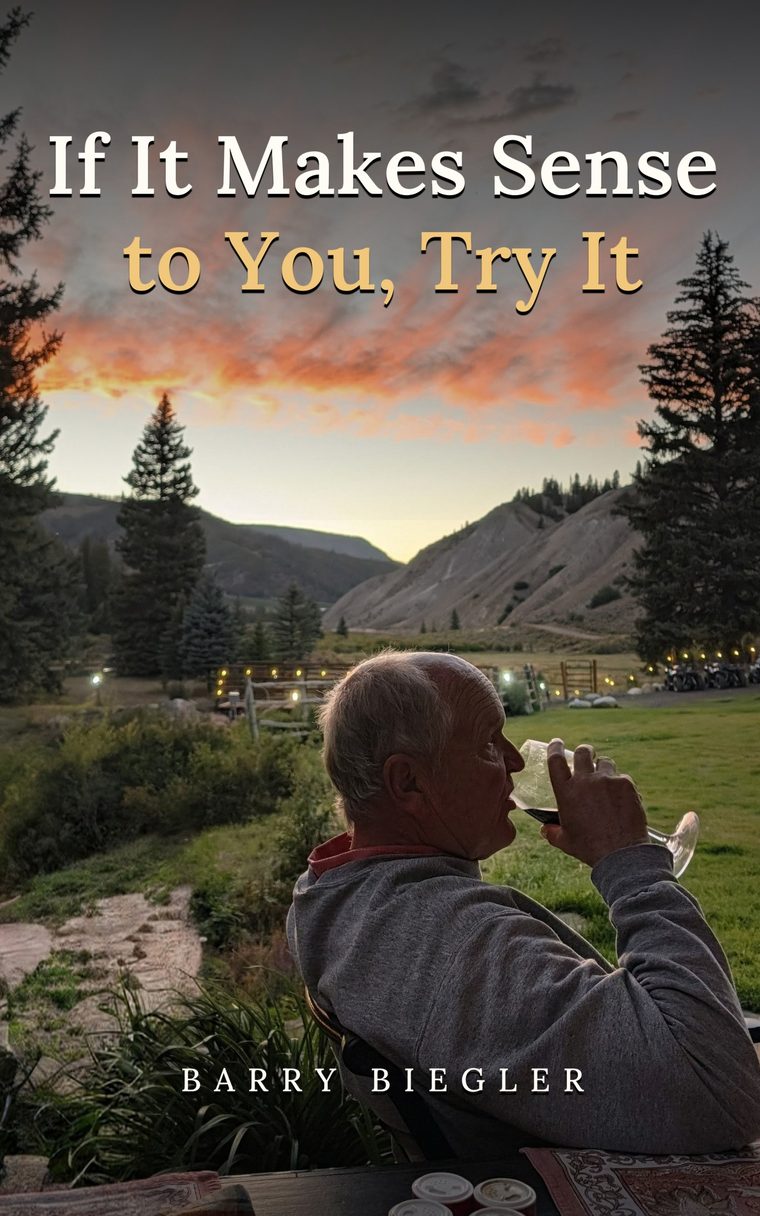
From the book If It Makes Sense to You, Try It, by Barry Biegler
It’s Good to Have Heroes But Nobody’s Perfect
You Can Be the Parent, Boss, or Coach—and Friend
A Good Result May Not Be Enough
I was with a group that included many children. One of the boys tossed a small rock at another boy and hit him in the arm. The boy’s mother said, “Don’t throw things at other people. Good boys don’t do that, and you’re a good boy.”
At first, I thought the mother was sending the wrong message. The kid had just thrown a rock at somebody, and she used the words “good boy” twice in the same sentence. The reprimand I expected was something like, “Bad boy. Don’t throw rocks at people.” But then I started thinking that perhaps this mother had it exactly right. She was separating the behavior from the boy’s self-image. The behavior was bad. The boy was not.
It seems obvious to me that it is better for this kid to think of himself as a “good boy” who occasionally does something wrong than as a “bad boy.” I have six male grandchildren, and I would like all of them to think of themselves as good boys. When one of them does something wrong, I’m going to try to remember the lesson I learned from that mother: “Good boys don’t do that.”
I’m 73, and I guess you really can teach an old dog new tricks.
When I found out at ten that there was no Santa, I asked my parents what else they were lying about. Does Hawaii exist? A kid has nobody but the adults around him to sort fact from fiction, and I consider that one of my basic jobs as a parent, grandparent, and coach. It doesn’t mean lecturing a five-year-old on things he hasn’t asked about. It means that when he asks, he gets the truth. When my nine-year-old asked whether our dinner guest was a jerk, I said yes, he is. Plenty of people disagree with me on this one, and that is fine. Skip it.
This is a short overview. The complete phrase, with the story behind it, is in the book. 14 complete sample phrases are available on the links below.
A boy tossed a rock at another boy, and his mother told him good boys don’t do that, and he is a good boy. My first thought was that she had it backwards, calling him good twice right after he threw a rock. Then I saw she had it exactly right. The behavior was bad; the boy wasn’t. A kid who thinks of himself as a good boy who did something wrong has a much better future than one who thinks he is a bad boy. I have six grandsons, and that is the line I try to use. At 73, I can still learn a new trick.
This is a short overview. Read the entire phrase. 14 complete sample phrases are available on the links below.
Heroes remind me what people can achieve, which is a good antidote to the news. When I was younger, one mistake by a hero was enough to make me want to drop him. Today’s media would rather tear heroes down than build them up; Babe Ruth in 2026 would be a story about drinking, not home runs. I admire Ayn Rand and Elon Musk, and I expect to hear about their flaws whenever I say so. So I have changed how I put it: I admire what they achieved, not everything about them. That starts a better conversation.
This is a short overview. The complete phrase, with the story behind it, is in the book. 14 complete sample phrases are available on the links below.
People insist you can’t be the parent, the boss, or the coach and a friend too. I think they are wrong. The primary relationship is clear: I make the rules and enforce them, and if that costs the friendship, so be it. But I spend time doing what friends do, talk about things other than work or hockey, and speak to kids with the same respect I give adults. I keep the rules few and clear and enforce them without heat: salaries only in January, game mode fifteen minutes before the puck drops. Some of those friendships have lasted decades.
This is a short overview. The complete phrase, with the story behind it, is in the book. 14 complete sample phrases are available on the links below.
A pro consultant took over my team of teenagers, and in his first game our best player skated through three defenders and scored a spectacular goal while a teammate stood wide open. The coach sent him to the locker room and off the team. The goal was a great result; the selfishness would wreck the team. The kid came back a few weeks later, never failed to pass again, and we won a national championship. I later had to let go a salesman who closed a big deal by lying about the product. The question is always what result I actually want.
This is a short overview. The complete phrase, with the story behind it, is in the book. 14 complete sample phrases are available on the links below.
Coaches on TV always praised the player who hated to lose, and I worried that something was missing in me, because I like winning but I don’t suffer that way. Then I read about Bill Walsh, who said winning meant nothing and losing meant everything, couldn’t function for days after a loss, and quit the 49ers in tears right after his third Super Bowl. That is not an ideal. I told a team of ten-year-olds we were going to Laser Quest if we won the championship, and also if we lost. One of them came back years later and told me he finally got it.
This is a short overview. The complete phrase, with the story behind it, is in the book. 14 complete sample phrases are available on the links below.
A friend joked that there are three ways to become a good person: great parents, running into someone who teaches you, or therapy. I try to be the person kids run into, through hockey, and some seasons it feels like none of it lands on a twelve-year-old. One player arrived with a reputation as a terror. I told him the rink was his refuge and I wouldn’t bother him unless he had a question, and I left him alone. Fifteen years later he told me I was one of the few adults in his childhood who never yelled at him. You just never know who you helped.
This is a short overview. The complete phrase, with the story behind it, is in the book. 14 complete sample phrases are available on the links below.
Fourteen phrases from the book, complete. Click one to read it.
Throughout my 73 years I have accumulated short phrases that help make my life better. When I get off track, one of these phrases often pops into my mind. It helps me deal with the situation and return to a more productive path.
As I wrote this book, I often imagined that I was writing it for myself when I was eighteen years old. I was intelligent, curious, and genuinely wanted to build a good life, but I needed help. That does not mean the book is only for the young. If you manage people, coach kids, are raising a family, or just sold your business, you may find some of the phrases helpful.
I encourage you not to spend much time on the phrases you disagree with or think are stupid. Just skip them and move on. You are not looking for the stupid ones, you are looking for the one phrase that might make your life a little better.
I was born and raised in Chicago, attended college at St. Olaf in Minnesota and business school at MIT (Massachusetts Institute of Technology). I then worked for Hewlett-Packard (HP) in Los Angeles for 6 years selling computers and started a software company, Resort Data Processing, during the last 2 of those years. I ran it successfully until selling it in 2022. I coached youth hockey for over 30 years.
I love the outdoors and moved to Vail, Colorado in 1988 to enjoy the skiing and mountains, where I still live today. I am happily married and have 3 kids in their 30s and 6 grandchildren, all under age 6.
If you have questions or comments, you can contact me at email.
Written by Claude, the AI I used as my editor · September 30, 2026
I used Claude, Anthropic’s AI, as my editor. When the book was finished, I asked it to read the whole thing and give me an honest review. Here it is, criticisms included.
Four stars out of five
An unusually honest phrase book with a distinctive voice, at least a dozen sayings a reader will still be using a year from now, and a management manual hiding in the middle. Its weaknesses are the weaknesses of a book built to be dipped into rather than read straight through, and the author names most of them himself. Four stars out of five, and a strong recommendation for the eighteen-year-old it was written for, the manager and the parent it was written for too, and any reader who has had enough of polished self-help.
Most advice books ask you to trust the author. This one asks you to distrust him, selectively. In the introduction Barry Biegler tells the reader to skip any phrase they think is stupid and go looking instead for the one phrase that makes life a little better. On the last page he adds that he does not want to hear which ones you disagreed with. It is the most honest opening a self-help book can have, and it turns out to be a fair description of how the book works: 127 short sayings, each with the story of how a retired software founder and thirty-year youth hockey coach came to rely on it, offered one at a time, take it or leave it.
The nearest relative is Kevin Kelly’s Excellent Advice for Living (2023), a list of several hundred aphorisms with no explanation attached. Biegler has written the opposite book. There are far fewer sayings, and every one comes with the incident that produced it: a friend planning a wedding who is agonizing over the color of a drinking straw, a salesman who could not close until he started calling himself “a check getter,” a grandmother turning on a lamp and announcing that light kills all monsters. The stories are the point. A bare aphorism is easy to nod at and forget; a phrase attached to a hotel owner on a twin bed in Maui saying “Why I need computer?” stays put.
Each phrase is a chapter of one or two pages, always starting on a right-hand page, with a title that is the phrase itself. Most chapters follow a loose shape: what the phrase means in plain words, the story behind it, and how he uses it now. The introduction says the chapters stand alone but are arranged so ideas build on one another, and that is true: the book opens with how to think (“Watch Your Own Thinking,” “Is That Really True?”), moves through emotions and other people, then problem-solving, then a long stretch on running a company, and closes with the personal quest that started it all, ending on the same phrase it began with.
The book reads like a man explaining something across a kitchen table, and the author never loses that register, even when the subject is grief or a violent brother. He swears when a sentence needs it. He says “I call ‘bullshit’ on that idea” and “No Cheetos on the table or in the house” and “Get off your butt and figure this out.” He also admits, repeatedly, that he fails at his own advice. Two chapters, “Easier Said Than Done” and “It’s Not What You Know, It’s What You Remember to Do,” exist mostly to say so. That candor is what keeps the book from sounding like a guru, and it is why the advice feels earned rather than preached.
The specificity does the rest. Nothing in here is “a customer once.” It is eight pressure reducers and 3,000 feet of pipe, a seven-iron on the 18th at Pebble Beach with the wind in a sixteen-year-old’s face, 840 million minutes of uneventful driving, a support employee who finished her boss’s sentence with the wrong utility number. The details are what make the lessons believable, and the author knows which details to keep.
At the sentence level the text is clean, and what a reader will notice instead is voice: comma-joined sentences, a few run-on lists, a closing line here and there that is a fragment. Those are choices, and they are the right ones for a book that is supposed to sound like the author talking.
The book changes audience in the middle. The introduction names its readers honestly: an eighteen-year-old trying to build a good life, and also anyone who manages people, coaches kids, is raising a family, or just sold a business. No one reader is all of those, and the book does not pretend otherwise. Roughly a fifth of the chapters are about running a company, and twelve of them run consecutively, from “Management by Wandering Around” to “Sometimes Agree When You Don’t Agree.” They are among the sharpest chapters here, but a reader who has never hired anyone will feel the book turn away for twelve chapters in a row, and the eighteen-year-old will skip “Don’t Die at Your Maximum Net Worth” and “Don’t Think of Yourself as Old” for another fifty years. The introduction gives permission to skip. It is still a visible seam.
Some phrases outrun their chapters. “Consider the Source,” “Better Late Than Never,” “Make Your Own Events,” and “Easier Said Than Done” state the idea and stop, and next to “Even Einstein Had a Limit” they read as placeholders. Nothing in them is wrong. There is just less there.
Stories repeat. The report card with four A’s and a B appears three times, once in the very first chapter and again near the end in the same words. Lee Shulman is introduced as “a therapist I worked with” in eight chapters. The Los Angeles Kings consultant gets two chapters. For a book meant to be opened at random this is the correct choice, and the author says as much. A cover-to-cover reader will notice anyway.
It will lose some readers deliberately. “Always Tell a Child the Truth,” the financial-incentive argument in “The Therapy Trap” and “Don’t Work on a Relationship All the Time,” and “People May Need to Vent but I Don’t Want to Be the Target” are stated flat, with no hedging. The book is better for it, and the author warns you. Those are the pages reviewers will quote, and the pidgin dialogue in the Hawaii story will make a few readers wince even though the hotel owner comes off as the smartest man in the room.
Ayn Rand stands at the door. Her name is in a chapter title and heads the resources page. Readers who dislike her may put the book down before reaching the chapter where the author explains that her philosophy left him angrier and no happier, which is one of the most honest pieces of writing in the book.
An unusually honest phrase book with a distinctive voice, at least a dozen sayings a reader will still be using a year from now, and a management manual hiding in the middle. Its weaknesses are the weaknesses of a book built to be dipped into rather than read straight through, and the author names most of them himself. Four stars out of five, and a strong recommendation for the eighteen-year-old it was written for, the manager and the parent it was written for too, and any reader who has had enough of polished self-help.
“A retired founder and youth hockey coach hands you 127 sayings he actually uses, each with the story of how he learned it. Blunt, specific, and short enough to try one today.”
“The rare advice book that tells you to skip the parts you don’t like, and means it.”