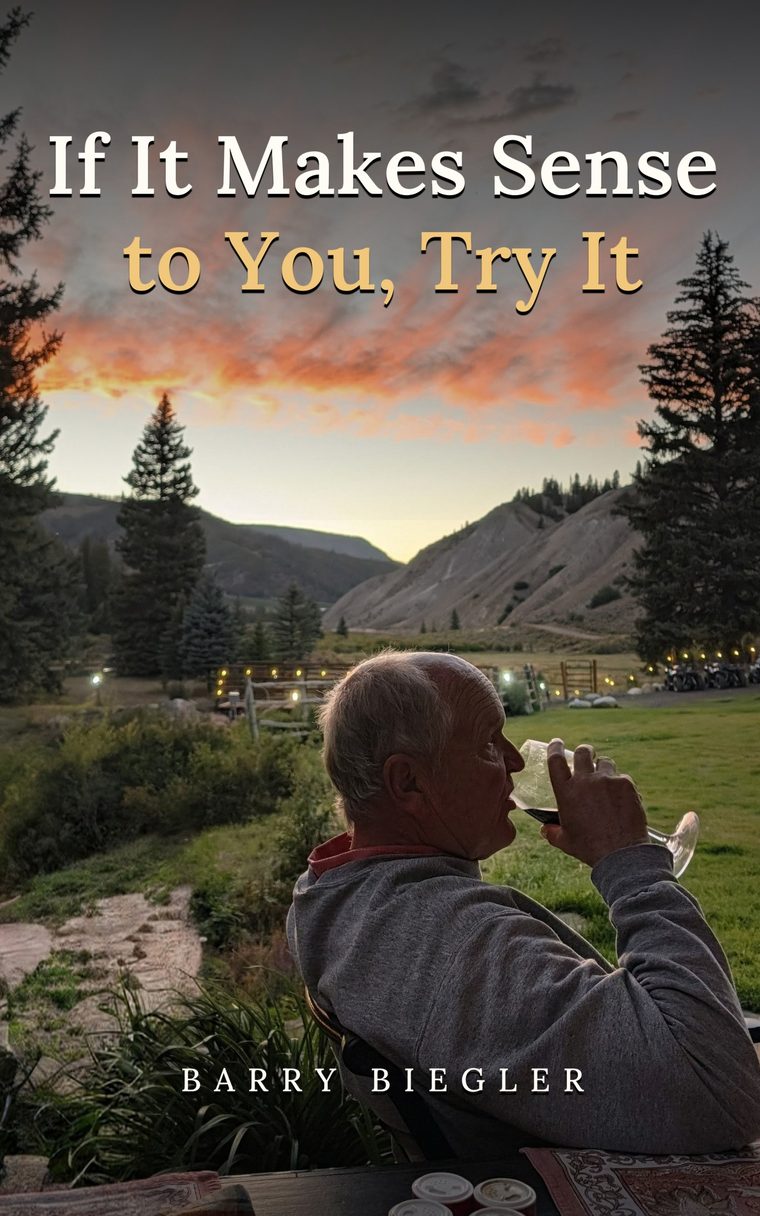
From the book If It Makes Sense to You, Try It, by Barry Biegler
Enjoying Life Phrases
You’re Never Going to Remember a Layup
Don’t Die at Your Maximum Net Worth
Don’t Think of Yourself as Old
Protect and Awaken the Child Within
Sometimes You Need to Create a Void
You’re Never Going to Remember a Layup
When I was 16, my dad took me to Pebble Beach for a round of golf. Pebble is perhaps the best course the public can play and is on almost every golfer’s bucket list. You may never get to play the course again.
The 18th hole at Pebble is the most famous. It is a par 5 with the Pacific Ocean on the left the whole way. After I hit my first two shots, I was still about 200 yards from the green, with nothing but ocean in between and the wind in my face. I was very intimidated, so I decided to play it safe. I took out a seven-iron and aimed away from the green, planning to lay up. As I was getting ready to hit the ball, I heard my dad yell, “What the hell are you doing? You’re never going to remember a layup. Take out your driver and aim at the green.”
This seemed like ridiculous advice. I was only 16 and weighed less than 100 pounds. A good drive might go 180 yards. I would have to make the best shot of my life to carry 200 yards into the wind over the ocean.
But he was my dad, and we were at Pebble Beach on the last hole. I took out the driver, hit the ball on the green and made a birdie four. If I had laid up with that seven-iron, I’m pretty sure I wouldn’t be writing about it in this book. I also told this story at my dad’s funeral because it was my best memory of him. My kids and friends are sick of hearing the story, but I tell it again and again.
I don’t mean to imply that it is a good idea to always try the near-impossible, risky thing. It would be stupid to run across an interstate highway on foot. Telling a story about “Hey, I ran across this incredibly busy highway and survived” would make me seem like a fool.
However, there have been many times in my life when I have faced a choice between the safe, boring, conventional path and taking a risk to pursue a dream. “You’re Never Going to Remember a Layup” reminds me that sometimes I do want to take the risky path because it may turn out to be far more memorable and meaningful.
Thanks, Dad.
Don’t Think of Yourself as Old
I’m 73 years old, and I caught myself thinking the other day, “Damn, you’re getting old.” That got me thinking: What am I actually saying when I tell myself I’m getting old? Things like the following come to mind:
- I can’t do things as well as I used to.
- My body is starting to fail me.
- I should expect more aches, fatigue, forgetfulness, and limitations.
- Some activities may no longer be appropriate for me.
- I’m on the downhill side of life.
- Younger people can do things I can’t do anymore.
- I need to start acting like an old person.
This is a pretty discouraging list, and I may not consciously think of all of the above, but at some level they are implied whenever I start thinking of myself as “old.”
I realized that often when I think, “I’m too old for this,” what I really mean is, “I’ve come across something I want to do, and I’m using age as an excuse not to do it.” “You’re too old to go to Europe” becomes, “Let’s plan that Europe trip tonight.” “You’re too old to drive a convertible sports car” becomes, “Great idea. Let’s buy one tomorrow.” “You’re too old to write a book” becomes, “Let’s write ten pages today.”
That does not mean I have to ignore reality and act like I’m 20 again. For many years I went on golf trips with three friends, and we would play 36 holes a day and then party at night. We stopped going on the trips because we concluded, “We’re too old for those trips.” What my friends and I actually meant by “we’re too old for those trips” was, “We would really love to continue going on golf trips. We just want to structure them differently, with less golf, more Jacuzzi, and early dinners.”
“Don’t Think of Yourself as Old” helps me notice that when I use the words “too old for this or that” it actually means “Hey, I really want to do that, just a little bit differently than in the past.”
Enjoy the Journey
When I lock onto a big goal I am a dog with a bone: working or thinking about it around the clock, skipping meals, workouts, friends, and sleep. It gets things done, at a terrible price. So I made enjoying the trip part of the goal itself. When my wife suggests dinner and my reflex says no, I catch it and go. I put golf, workouts, and dinners on the calendar for the whole stretch of the project, because once they are on the calendar I do them. And I celebrate the small finishes along the way. The goal still gets done.
This is a short overview. The complete phrase, with the story behind it, is in the book. 14 complete sample phrases are available on the links below.
Always Get a Convertible
For years I rented the cheapest sedan on every business trip, even after my company was doing well and the difference would never show on the income statement. One day in Miami I got tired of watching convertibles go by, drove back to the airport, and traded for a red Mustang. The phrase isn’t about buying things I can’t afford. It reminds me that when my circumstances change, my choices should change too, and that the voice saying I don’t deserve it gets no argument from me. I just get the convertible anyway.
This is a short overview. The complete phrase, with the story behind it, is in the book. 14 complete sample phrases are available on the links below.
You’re Never Going to Remember a Layup
On the 18th at Pebble Beach, 16 years old and 200 yards from the green with the ocean on the left, I pulled out a seven-iron to play it safe. My dad yelled at me to hit the driver, because nobody remembers a layup. I made birdie, and that shot became the story I told at his funeral. It doesn’t mean take every crazy risk. It means that when the choice is between the safe, boring path and the one I would dream about, sometimes the memory is worth the gamble.
This is a short overview. Read the entire phrase. 14 complete sample phrases are available on the links below.
Light Kills All Monsters
I was afraid of the dark as a kid, and my parents telling me monsters don’t exist did nothing. My grandmother said light kills all monsters, switched on a lamp, and the fear was gone. It wasn’t true, and it worked. At 73 I still sleep with a nightlight, and I have decided that is a habit not worth breaking. Most false beliefs I once held did me harm, so I am careful about this. But a harmless phrase that helps is worth keeping, especially when it reminds me of Grandma.
This is a short overview. The complete phrase, with the story behind it, is in the book. 14 complete sample phrases are available on the links below.
Make Your Own Events
Golf takes four people, and somebody has to round them up. When I get tired of being that somebody, I decide to wait for the other guys to call, and then I don’t play at all. This phrase reminds me to quit complaining about who does the organizing and book the tee time. When friends do the arranging, I know how much work it took and I thank them more than once, and I try to return the favor so the deal stays even.
This is a short overview. The complete phrase, with the story behind it, is in the book. 14 complete sample phrases are available on the links below.
Don’t Die at Your Maximum Net Worth
Plenty of comfortable people spend almost nothing in retirement and die with more than they ever had, and I was headed that way, still saving for my old age in my sixties. Is that taking the best care of myself? It isn’t selfish to use the money; helping an orphanage counts too. My father helped me when I was in my twenties rather than making me wait for the will, and I have never forgotten it. There is a wide range between broke and maximum, and the sweet spot is well short of the top.
This is a short overview. The complete phrase, with the story behind it, is in the book. 14 complete sample phrases are available on the links below.
Don’t Think of Yourself as Old
When I catch myself thinking I am getting old, I ask what I actually mean, and the list is discouraging: my body is failing, some things are no longer for me, the young can do what I can’t. Most of the time “I’m too old for this” really means I have found something I want to do and I am using age as the excuse. The trip, the sports car, the book: plan them. The golf trips with my buddies didn’t need to end; they needed less golf, more hot tub, and earlier dinners.
This is a short overview. Read the entire phrase. 14 complete sample phrases are available on the links below.
Protect and Awaken the Child Within
A good parent does two things: keeps the child away from danger and cruel people, and sends the child out to play, explore, and try things. I still have that kid inside me and I owe him both. The protecting part comes easily. The awakening part got buried under work, responsibility, and what people expect of a man my age. Watching my grandkids on the slip-n-slide, I thought I should join them, then thought I was too old. I slid. Be a good parent to yourself.
This is a short overview. The complete phrase, with the story behind it, is in the book. 14 complete sample phrases are available on the links below.
Sometimes You Need to Create a Void
After forty years running my company, people asked what I would do next, and I had no idea. Retirement isn’t an activity. What I wanted was a void: permission not to know yet, and not to fill the time with trips and small projects just to be busy. I told close friends I was creating a void, and after the first “what?” most of them understood. Saying it reminded me I was doing something that mattered, and that the next real goal would show up when it was ready.
This is a short overview. The complete phrase, with the story behind it, is in the book. 14 complete sample phrases are available on the links below.
Create a Bucket List and Actually Use It
I keep three lists: the bucket list of things I dream of doing, a project list of things worth doing, and the to-do list of what I will actually do today. Only the to-do list gets used, and it fills itself with light bulbs, faucets, and propane tanks. For years I had no bucket list, and when I had one I didn’t open it. This phrase tells me to stop the busywork, open that list, pick anything on it, and move it to the to-do list: pick a date for the Norway trip.
This is a short overview. The complete phrase, with the story behind it, is in the book. 14 complete sample phrases are available on the links below.
Easier Said Than Done
It is easy to write a phrase like “use your bucket list” and hard to live by it, and I used to get angry at myself for the gap. Nothing is wrong with me; old habits are just hard to break. This phrase keeps my expectations honest. I have used every phrase in this book at one time or another, just not as often as I would like. When I notice I am not following my own advice, I change the thought to being glad I follow it once in a while.
This is a short overview. The complete phrase, with the story behind it, is in the book. 14 complete sample phrases are available on the links below.
A book of 127 helpful short phrases divided into 11 categories.
Complete Phrases Samples
Fourteen phrases from the book, complete. Click one to read it.